27 Mar 2007

The streets are alive - with the signs of history

    Just up the street from us and to the left, there is a small road where we get our laundry done - it's election year, as even their window, filled with flat irons from when laundry was even harder work, cheekily reminds us (with models of Royale and Sarkozy):


    But in 1794 a small, somewhat insignificant man walked in this road (which was then the road to VilleFranche), for nine months, leaving and returning to number 6 (then owned by a count). At that time this little man was already commandant of the French army of Italy.


This small road is now called "Rue Bonaparte" - which seems a rather meager tribute, and that small man went on to change France and to give the aristocratic Brits a fright - even the Duke of Wellington said of the battle of Waterloo:

    "It has been a damned nice thing — the nearest run thing you ever saw in your life... By God! I don't think it would have done if I had not been there."

    Creevey Papers, ch. x, p. 236


To be fair, he also said of Napoleon:

    "I used to say of him [Napoleon] that his presence on the field made the difference of forty thousand men."

    Notes of Conversations with the Duke of Wellington, Stanhope, November 2, 1831


Arrogant Aristocrats

Personally I wish the French had won, then we would also have had the sensible metric system a lot earlier - AND better food ! More importantly we wouldn't have been ruled by ignorant and arrogant aristocrats for so long, e.g., Wellington, who later became Prime Minister, said of his own army:

    "Ours is composed of the scum of the earth—the mere scum of the earth."

    Notes of Conversations with the Duke of Wellington, Stanhope, November 4, 1831


And of demands for the reform of Parliament he said:

    "I am not only not prepared to bring forward any measure of this nature, but I will at once declare that, as far as I am concerned, as long as I hold any station in the Government of the country, I shall always feel it my duty to resist such measures when proposed by others."

    Cited in "The House of Lords: A handbook for Liberal speakers, writers and workers" (Liberal Publication Department, 1910), p. 19.


When the Parliament was reformed, despite his bitter opposition, his response was:

    "I never saw so many shocking bad hats in my life."

    Sir William Fraser, Words on Wellington (1889), p. 12


This ex-general couldn't even appreciate at least the military potential of of the railways:

    "Depend upon it, Sir, nothing will come of them!"

    Paul Johnson, The Birth of the Modern (1991), p.993


The failure of British industry, it has been argued, was due in part to attitudes like this, fostered by the public school system and its usual scorn for anything to do with manual work or industry (see the quoation from the British Consul in Nice below).

    "Eric Hobsbawm, who considers Public Schools in the context of Britain's rise and decline, treats them harshly and convincingly:

    'The assimilation of the British business classes to the social pattern of the gentry and aristocracy had proceeded very rapidly from the mid nineteenth century, the period when so many of the so-called "public schools" were founded, or reformed by finally excluding the poor for whom they had originally been intended. In 1869 they were more or less set free from all government control and set about elaborating that actively anti-intellectual, anti-scientific, games-dominated Tory imperialism which was to remain characteristic of them. (It was not the Duke of Wellington but a late-Victorian myth which claimed that the battle of Waterloo was won on the playing-fields of Eton, which did not exist in his time.)

    Unfortunately, the public school formed the model of the new system of secondary education ... The British therefore entered the twentieth century and the age of modern science and technology as a spectacularly ill-educated people.'"

    http://www.victorianweb.org/history/education/eh4.html


it would be more accurate to say that many of the battles of the First and Second World Wars were lost on the playing fields of Eton, Harrow, etc.

Encouraging engineering

In contrast the young Napoleon established the Ecole Polytechnique:


    "After the chaos of the French Revolution, Napoleon decided he needed to start over. In 1794 he replaced Perronet's school with the École Polytechnique, and the game changed. The École Polytechnique hosted the greatest mathematicians and theoretical mechanicians of that age -- Biot, Arago, Fourier, all names that we engineers know very well.
    ...
    What Napoleon gave technology could never have sprung from a craving for monuments [which he later developed]. The young, idealistic Napoleon laid a foundation for engineering education... He gave us the people who really do build our world."

    http://www.uh.edu/engines/asmedall.htm (highly recommended)


Though in France too, old elitist attitudes led to an over-emphasis on theory, which still exists to some extent. But some Frenchmen fought that too as early as 1834, e.g. Francois Arago:

    "Soon after, he wrote a second paper to defend himself. He titled it, On Machinery Considered in Relation to the Prosperity of the Working Classes. It says things most of us take for granted: Machines don't steal jobs, they create them. Machines make goods affordable to the poor. And so on.

    By now, of course, the new engines really had become monsters. Four years after Arago's talk, Charles Dickens published Oliver Twist. Dickens woke the English public to the horrors of industrial slums. And a new wave of social reform had to begin.

    But Arago celebrated the humanitarian impulse that drove people like James Watt in the first place. Watt really did create machines in the interests of the common people of whom he was one. And which of us would exchange our everyday lives today for the lives we lived before Watt - or before Arago."

    http://www.uh.edu/engines/asmedall.htm


What - before the internet and Macs ? No thank you ! :-)

I was going to say that Britain owed its lead in the industrial revolution to practical British men (see the reference to James Watt above) like Isambard Kingdom Brunel - then I find that his father was born and educated in France and Isambard "was sent by his father to the College of Caen in Normandy, France when he was 14 years. He later went to the Henri Quatre school in Paris." !


http://web.ukonline.co.uk/b.gardner/brunel/kingbrun.html


Many French were and still are Anglophiles, so Wellington went too far when he said:

"We always have been, we are, and I hope that we always shall be, detested in France."

(All quotations from Welligton at http://en.wikiquote.org/wiki/Arthur_Wellesley)

Nice becomes accessible to the masses

Brits were certainly welcomed back in Nice (which even then depended on tourists) after their long absence during the Napoleonic wars, and Brits were still welcomed when Nice later became French. When the railway finally came to Nice, many British aristocrats regretted that the lower orders were now able to enjoy it too. In 1884, J. C. Harris, the British Consul wrote:

    "I do not want to say, thank God, that there are not still many respectable people in Nice; but it is also true that you see here [NB] quite a number of captains of industry, people of both sexes of more or less blemished reputation, people who affect titles to which they have no right, hiding their true, sad selves..."

    Quoted in "High Season in Nice", Robert Kanigel (highly recommended), p. 128


Garibaldi and the Cassini dynasty

Rue Bonaparte leads to Place Garibaldi. Garibaldi was born in Nice, but is famous for his activities in Italy. The statue is about to be moved a few metres due to the new tramway - which Nice had decades ago, now expensively reintroduced for a more ecology-conscious age - the first trial run over a short section took place today !


    "Garibaldi, Giuseppe (1807-1882) The foremost military figure and popular hero of the age of Italian unification known as the Risorgimento with Cavour and Mazzini he is deemed one of the makers of Modern Italy. Cavour is considered the "brain of unification," Mazzini the "soul," and Garibaldi the "sword." For his battles on behalf of freedom in Latin America, Italy, and later France, he has been dubbed the "Hero of Two Worlds." Born in Nice, when the city was controlled by France, to Domenico Garibaldi and Rosa Raimondi, his family was involved in the coastal trade. A sailor in the Mediterranean Sea, he was certified a merchant captain in 1832. During a journey to Taganrog in the Black Sea, he was initiated into the Italian national movement..."

    http://www.ohiou.edu/~chastain/dh/gari.htm


From Place Garibaldi, the grander Rue Cassini leads to the Port. The name Cassini would be recognised by many around the world today, but for something named after him, rather than because they have any idea who the man was:

    "Giovanni Domenico (or, in French, Jean Dominique) Cassini was born on June 8, 1625 in Perinaldo (near Nice, now France). He studied mathematics and astronomy at the Jesuits and became professor of astronomy at Bologna, as well as fortress builder, at age 25.
    ... [he] collaborated with Christiaan Huygens in many astronomical projects.


    ... He discovered Saturn's moons Iapetus (1671), Rhea (1672), Tethys (1684), and Dione (1684). In 1675, Cassini discovered that Saturn's rings are separated into two parts by a gap, which is now called Cassini Division in his honor; he (correctly) presumed that Saturn's rings were composed of myriads of small particles.
    ...
    Cassini was the founder of a dynasty of four astronomers in Paris: His son Jaques Cassini (Cassini II, 1677-1756), his grandson César François Cassini (Cassini III, 1714-84) and his grand-grandson Jean Dominique Cassini (Cassini IV, 1748-1845) followed him as directors of the Paris Observatory. In 1711 Cassini got blind, and died on September 14, 1712 in Paris.


    "G.D. Cassini (or Cassini I) was multiply honored by the astronomical community, in some cases together with one of his descendants: Nasa/ESA's Cassini spacecraft to Saturn was named after him ..."


http://messier.obspm.fr/xtra/Bios/cassini.html

A new Napoleon ?

In Rue Cassini, which runs almost parallel with the smaller Rue Bonaparte, there is the local election headquarters of another small man, Sarkozy, who also wants to run France - ironically in a more Anglo-Saxon way:


It looks as if he might succeed - unfortunately. The slogan says: "Together everything becomes possible" - including developing the same increasing gap between rich and poor which we have seen over recent years in the US and UK:

Rich-poor gap grows in US and UK

    "George Bush’s tax cuts for the wealthiest 1% in society is just one example of this cosy alliance between our leaders and those who frankly, already avoid paying more tax than a patriot ought to.

    Of course, this could only happen in the USA, right? Erhh, no. Actually the size of the gap between the richest and poorest 20% of society has been growing in the UK since the late 1970s almost mirroring the USA (graph below). If you wonder how much privatisation and financial deregulation have to do with this, look to Russia (right) where, since the population were ‘liberated’ from the shackles of communism in 1990, the rise in inequality has been acute."

    http://www.ablemesh.co.uk/thoughtsgaprich&poor.html

    Cf.: "Sir Peter Lampl, chairman of the Sutton Trust, said: 'These findings are truly shocking. The results show that social mobility in Britain is much lower than in other advanced countries and is declining - those from less privileged backgrounds are more likely to continue facing disadvantage into adulthood, and the affluent continue to benefit disproportionately from educational opportunities."

    http://www.lse.ac.uk/collections/pressAndInformationOffice/newsAndEvents/archives/2005/LSE_SuttonTrust_report.htm


Wellington would have approved. Meanwhile our new little Napoleon sees developments in the US and UK more favourably, and in the UK the Economist doesn't just report on him, it puts the case for him - as a new Napoleon:


    " 'However, on a trip to Washington last year his declaration that he was proud to be a "friend of America" received a hostile response back home and he has restated his long-held opposition to the war in Iraq. But he is also desperate for new allies in the EU and his intentions to shake up France's sclerotic economy has led him to favour aspects of the "Anglo-Saxon" model, which many in France dread.' Guardian

    OK, here we go. "desperate for new allies" seems to be the only authorised description of French (or German, for that matter) leaders in the UK press - even in the Guardian, it would seem.

    "sclerotic" seems to be the only authorised description of the French economy - despite the fact that its growth per capita since 1994 is essentially identical to that in the UK."

    Jerome a Paris

    http://www.eurotrib.com/story/2007/1/30/162959/935


But the climate here in Nice encourages one to be positive, even if Sarkozybecomes President he isn't going to lead France into Napoleonic wars - Wellington also said: "Nothing except a battle lost can be half so melancholy as a battle won."

Dispatch from the field of Waterloo (June 1815)

The European century ?

Nor is Europe likely to tear itself and much else to pieces with engineers corrupted into the creators of weapons for mass slaughter as in the two world wars. Indeed Sarkozy is quite mistaken to look to the US as any kind of model; as Mark Leonard convincingly argues in his encouraging book:


Europe, he argues, offers a model other countries want to join, it doesn't try to impose a system on them by "Shock and Awe", it encourages them to become eligible for this successful club by reforming themselves first.

The two world wars and the absence of tourists brought Nice to its knees, now it can seem too popular again - like France in general. Sarkozy promises a "rupture" but he promises that it will be one that is "tranquille". The French have much that is worth holding on to as Royale emphasizes. The next time anybody suggests that France should be more like the UK - just point them to this story of two British friends of 40 years, who had heart attacks within a week of each other, one in the UK the other in France, George:

    "My treatment has been excellent. I am sure that because there are no price constraints here in France, the doctors and specialists are always happy to go that one step further. If there is the slightest problem you are hospitalised because they don’t want to take any chances. The hospitals are very clean and I was only ever in a ward with one other person. The meals were superb – I always looked forward to eating them and because this is France, it often came with a small bottle of red wine!

    http://www.frenchentree.com/fe-health/DisplayArticle.asp?ID=19319


The difference in treatment makes me feel very reassured to be here in Nice - it's just anecdotal, but it matches a lot of other anecdotes and the WHO survey of health systems in which France came first.

Time for a stroll down these very historic streets, in the warmth of the winter sun, and a cool beer on the beach.


26 Mar 2007

"Cool Vibes"

    One of the good things about being in the Port area of Nice (till we move to the north of the city in April) is that there are so many bars, small theatres and restaurants in the area. I noticed a poster for one which had jazz on sat night, so though feeling a bit lazy, we made the very tiny effort to walk round the corner. We just wanted to drink, but unfortunately were given a table which, though it had a great view of the band, was far too close.


    While this kept us quiet, it didn't stop the conversation of the young couple just behind me (they sounded like Americans I have to say) who just talked more loudly. Then the rather fastidious M didn't like her gin fizz, nor the playing of one of the musicians. So we left early, I a bit grumpy that my discovery and minor effort had not worked out. Oh well, there are plenty ofother choices - recently we discovered that "The Authentic", near the Etoile, had jazz on Fridays and Saturdays, seems quite "sympa" and will try that soon.


24 Mar 2007

French dentist wine buff

    Fri. I had some more work done on my teeth, including whitening (years of coffee and red wine had taken their toll). Afterwards the dentist (who speaks English quite well, but is apologetic about it, like a lot of French - it's because they don't like to make errors according to Polly Platt in "French or Foe"), told me to avoid tobacco, coffee and red wine. I said I didn't smoke but the red wine would be a problem.

    The conversation abruptly changed from medical considerations to a very French concern with wine. "Red wine - n'importe quelle sorte?" he asked, and said that he liked Bourgone. I tried what I thought was a safe response: "St. Emilion" ? He wasn't particularly keen on it. I admitted that actually I quite liked Australian wine (an absurdly wide category in itself). He conceded it could be good.

    But I promised to try to avoid all red wine for a while anyway and we got back to business and arranged another appointment. Where but in France, would you have a chat like that with your dentist as he's telling you to keep off the stuff ? :-)

Some men learn to cook - finally


Fri. I went to the first morning of a short cookery course, organized by the local AVF (Accueil des Villes Francaises) - for men !

We took most of it very seriously, even exactly how to cut up tinned tomatoes:


M. had bought me a very elegant 'tablier" from Habitat - elegance is a necessity in all things for her:


Les recettes:


A woman looks doubtful about this stuff cooked up by us guys:


But it was fine - however next month we have to cook for lots of women in the evening !

See more here


22 Mar 2007

Did YOU sleep well ?


An Iraq Interrogator's Nightmare

By Eric Fair [I'm not making this up!]

Friday, February 9, 2007; Page A19

      "A man with no face stares at me from the corner of a room. He pleads for help, but I'm afraid to move. He begins to cry. It is a pitiful sound, and it sickens me. He screams, but as I awaken, I realize the screams are mine.

      That dream, along with a host of other nightmares, has plagued me since my return from Iraq in the summer of 2004. Though the man in this particular nightmare has no face, I know who he is. I assisted in his interrogation at a detention facility in Fallujah. I was one of two civilian interrogators assigned to the division interrogation facility (DIF) of the 82nd Airborne Division. The man, whose name I've long since forgotten, was a suspected associate of Khamis Sirhan al-Muhammad, the Baath Party leader in Anbar province who had been captured two months earlier.

      The lead interrogator at the DIF had given me specific instructions: I was to deprive the detainee of sleep during my 12-hour shift by opening his cell every hour, forcing him to stand in a corner and stripping him of his clothes. Three years later the tables have turned. It is rare that I sleep through the night without a visit from this man. His memory harasses me as I once harassed him.

      Despite my best efforts, I cannot ignore the mistakes I made at the interrogation facility in Fallujah. I failed to disobey a meritless order, I failed to protect a prisoner in my custody, and I failed to uphold the standards of human decency. Instead, I intimidated, degraded and humiliated a man who could not defend himself. I compromised my values. I will never forgive myself.

      American authorities continue to insist that the abuse of Iraqi prisoners at Abu Ghraib was an isolated incident in an otherwise well-run detention system. That insistence, however, stands in sharp contrast to my own experiences as an interrogator in Iraq. I watched as detainees were forced to stand naked all night, shivering in their cold cells and pleading with their captors for help. Others were subjected to long periods of isolation in pitch-black rooms. Food and sleep deprivation were common, along with a variety of physical abuse, including punching and kicking. Aggressive, and in many ways abusive, techniques were used daily in Iraq, all in the name of acquiring the intelligence necessary to bring an end to the insurgency. The violence raging there today is evidence that those tactics never worked. My memories are evidence that those tactics were terribly wrong.

      While I was appalled by the conduct of my friends and colleagues, I lacked the courage to challenge the status quo. That was a failure of character and in many ways made me complicit in what went on. I'm ashamed of that failure, but as time passes, and as the memories of what I saw in Iraq continue to infect my every thought, I'm becoming more ashamed of my silence.

      ... I am desperate to get on with my life and erase my memories of my experiences in Iraq. But those memories and experiences do not belong to me. They belong to history. If we're doomed to repeat the history we forget, what will be the consequences of the history we never knew? The citizens and the leadership of this country have an obligation to revisit what took place in the interrogation booths of Iraq, unpleasant as it may be. The story of Abu Ghraib isn't over. In many ways, we have yet to open the book."

      The writer served in the Army from 1995 to 2000 as an Arabic linguist and worked in Iraq as a contract interrogator in early 2004. His e-mail address is erictfair@comcast.net.

http://www.washingtonpost.com/wp-dyn/content/article/2007/02/08/AR2007020801680.html


Meanwhile - "there's a war going on"


As I said in the cafe-philo on Monday, now there is the internet and you can, from the comfort of your home in Nice, for example, read blogs of Iraqis living through the war. You can also, thanks to www.YouTube.com, listen to an American-Iraqi rapper, TIMZ. I don't usually like rap, with its often absurd glorification of violence and misogynistic attitudes, but this one is different, a serious criticism of the attack on Iraq. Well worth a play:


    "Iraqi-American rapper TIMZ has released a politically charged music
    video that is getting international attention since its debut on
    YouTube.com.

    "Iraq" is destined to be a true rallying cry during these difficult
    political times. TIMZ's background allows him to give a unique
    perspective of the war. "My parents are from Iraq but I was born in
    the United States. I feel like I'm able to connect to both sides of
    this war a little more than the average person. That's why I wrote
    the song the way I did; the first verse is written from the
    perspective of an Iraqi while the second verse is written from the
    perspective of an American. The third verse is a history lesson!"

    "Dear Mr. George Bush," TIMZ raps. "Why do you insist to make a fool
    of us? For over 200 years... we stood for what's good, now we
    despised by our peers; And what do you...but add fuel to the fire and
    send in more troops. Oh the troops God save the troops; it wasn't
    their war their lies their fault. America the beautiful what did they
    do to you, they used you its so indisputable!"

    On his fiery and autobiographical debut CD, TIMZ—aka Tommy Hanna, an
    American born rapper of Chaldean and Iraqi descent--gets right up in
    our faces, mixing explosive, Middle Eastern tinged beats with
    incendiary rhymes in an effort to shatter those ugly stereotypes that
    have plagued people who look like him since 9/11 and the start of the
    Iraq war.

    Make no mistake, the title of TIMZ powerful, outspoken and heavy
    grooving 14- track collection—a nominee for Best Hip-Hop Album at the
    2006 San Diego Annual Music Awards—says it all: the San Diego born
    and bred artist is Open For Business."

    "Iraq" was directed by Ron Najor at TheBuzzLA.com


Then an unexpectedly respectful interview with him on - FOX TV !
(including Chuck Norris, ex-karate champ and actor in Kung Fu films). If Fox is treating
opponents of the war this well you know the war is lost.


http://www.youtube.com/watch?v=4IpCuucaZBI&NR

You can also easily share such things with others. An ex-student of mine commented:

    "Thanks for that Ted, I've sent it to all of my friends.
    It's a great song and the interviews with the singer are realy good.
    It's also great to see the hiphop genre used for serious comment, other
    than Rage Against the Machine not too many people have used it
    hiphop/rap so effectively."

AVF - pub philosophy/Brit reserve

Tuesday we went to an AVF meeting (Accueil des Villes Francaises) which was to discuss future activities and the election of a new president. Some food was available (mainly salad, but anyway, we'd already eaten), and people brought drinks - M had got two bottles of Kir Royale.

Pub-philo ?

After some eating and drinking, and the announcement of her candidature for the role of president of the Nice AVF by the organizer of the event ) I was rash enough to offer to run a cafe-philo - but in English.

It seems there aren't many Brit members of AVF and maybe some actvities in English might bring in some of the many Brit ex-pats in Nice. While philosophy isn't so endemic in the UK (The French study it at school for the BAC - and there is such interest that the BAC philo questions and responses from some philosophers are published in even quite popular papers). However, with a typically British twist, there are some pub-philosophy meetings in the UK, so it might have some appeal, especially if it's kept non-technical, and a few with some knowledge aren't allowed to monopolise the discussion, as sometimes happened in one of the pub philosophy groups I went to in London.

Welcoming us Brits

Maybe a discussion group in English on cultural differences, for French (interested in practising their English) and Brits/Americans and anyone else interested, might appeal too. I think Brits tend not to join the AVF, partly due to being rather reserved (before a few drinks) and because the AVF seems to be for French moving into the area and most activities require a reasonable grasp of French. But most Brit ex-pats are probably more in need of "accueil" and help than the French from other parts of France.

Nietzsche in Nice

It was appropriate that, after the cafe-philo evening, the next day I finally got around to taking a photo of the plaque commemorating Nietzsche's first winter stay just down the road, at 38, Rue Catherine Segurane:


    "He then moved farther [19] west to Nice, where both the elegance of the old city [20] and the power of the sea [21] [22] [23] captivated him. Nietzsche also enjoyed vigorous walks in the mountains at Èze, east of Nice, on what is today called the "Nietzsche Path" [24]. The beauty of the Parc du Château [25], above the Old City of Nice, never disappointed him, even as his eyesight continued to deteriorate almost to the point of blindness."

    http://www.press.uchicago.edu/Misc/Chicago/452786.html


Nietzsche's terrace in the Parc de Chateau


Nietzsche himself said:

    " 'Nice and the Engadine [Switzerland]: that is the circle dance this old nag cannot escape. . . . To be sure, there can be no more beautiful season in Nice than the current one: the sky blindingly white, the sea tropical blue [21], and in the night a moonlight that makes the gas lanterns feel ashamed, for they flush red. And here once again I perambulate, as so many times before, thinking my kinds of thoughts, ebon thoughts."—Letter to Malwida von Meysenbug, December 13, 1886'

    http://www.press.uchicago.edu/Misc/Chicago/452786.html


20 Mar 2007

Cafe-philo/media

Monday we went to that very French institutuion, a cafe-philosophy meeting. This one was at the Brasserie Felix Faure (once again just a walk away):


"Toute la variété et tout le savoir-faire d'une grande brasserie... La clientèle, essentiellement niçoise ... Dans cette immense brasserie au style très parisien, on sert en continu jusqu'à tard le soir."

http://www.fra.cityvox.fr/restaurants_nice/brasserie-felix-faure_52028/Profil-Lieu

The subject was: The influence of the media - just like so many seminars I've run in the past, except that this was in French of course.

At first I thought I probably wouldn't contribute, but after a while couldn't resist, especially when one guy seemed to be arguing that we were all aware of media manipulation and little influenced by them now.

US Media and Iraq

I said that of course the media have an effect, e.g. the majority of Americans believing that Iraq was involved in 9/11, because the US media, afraid of being seen as unpatriotic, merely echoed the insinuations of the Bush gang. On the other hand, as Chomsky has pointed out, there is scope for optimism. Despite years of pro-market propaganda most Americans still want some kind of national health service.

I also added that it was misleading to speak of the media in a general way; they were very diverse, especially now with the internet, when we could read on-the-spot blogs from people in places like Iraq.

More misunderstanding of objectivity

When "objectivity" came up I had to make the points that it wasn't equivalent to absolute truth (and hence supposedly unobtainable), rather it is a process, the use of the kind of techniques employed in science for getting at the truth, which was sometimes very evident - Iraq is a disaster now.

Nor is it "balance" - see the earlier post on cultural differences and Fisk on this subject. Sometimes the truth is very clearly on one side - and opinions should not be treated equally when some are clearly absurd - e.g. that Iraq was a threat to us - even most of its neighbours didn't feel threatened. See also the earlier post's reference to Martha Gellhorn's experience of the liberation of Dachau - the Nazis clearly were bad guys.

I also had to disagree with another ex-lecturer who claimed that even his own benign teaching had been manipulation. This is just a misuse of the word; to be honest with people is not to manipulate them, even if one has an effect on them, especially when, as some of my ex-students have been kind enough to say, I encouraged them to think for themselves.

"Personne ne peut philosopher a notre place ... elle est une dimension constitutive de l'existence humaine."

Andre Comte-Sponville, Presentations de la Philosophie, p.13

Unfortuntely the democractic procedure of voting on suggestions for the next topic (mine was: "Why are French intellectuals right-wing?" - based on a recent piece in Le Nouvel Observateur) led to the choice of: "What is the difference between philosophy, science and religion?" As another ex-lecturer remarked to me: "That should take a few weeks."

18 Mar 2007

Beach reading, Rugby, Vintage Cuisine and Duende

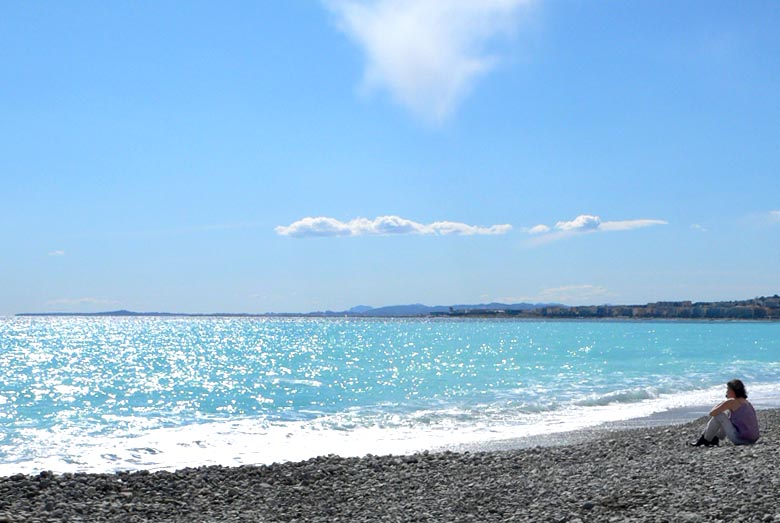
Saturday we walked by the Port and round to the Promenade des Anglais, to be reminded how lucky we are by the tents of the homeless - though if you are homeless there are far worse places to set up temporary home:


We went along to the Lido Plage for beers and for M to read some stuff about getting work while I continued with Mark Leonard's "Why Europe Will Run The 21st Century" - some eye-opening statistics (more later).

It started out warm enough to be in a short-sleeved shirt, but later some mist and cloud developed and we left at about 5pm.


We walked back via Cours Saleya. The Irish pub was crowded with Rugby fans so we walked on to a pub which was just opening up, so was quiet and we were able to watch the end of the France - Scotland match, in which the French team made up for their earlier defeat by the English (not that I'm really interested). After a couple of large Leffes there we decided to have an early meal and decided the Vintage, 20, r Barillerie, looked good, so was the food and our young French neighbours didn't smoke ! They even had some Californian wine which I still tend to prefer to most French wine. M. said that one would have to get a ten year old French wine to find something as good, due to rules about French wine production.

On the way back we stopped to listen to a couple of gypsy guys, one playing guitar the other singing, some of the songs were by the Gypsy Kings, old favourites of mine.


We offered them drinks (M speaks Spanish) and then to join us inside where M got a hot chocolate for the young guy who seemed to be very cold but who sang with what sounded to me like a great deal of duende (feeling/spirit).